


Reading time
33 mins
Last updated
Mar 18, 2026
AI Shopping Assistant Guide 2026: How Agentic Commerce Protocols Are Changing E-Commerce
 Your customers are starting to shop without ever visiting your website.
They ask an AI shopping assistant for a product recommendation. The assistant searches structured product feeds, surfaces your competitor’s hiking boots alongside a “Buy” button, and the customer checks out. All without leaving the chat. No Google search. No click-through. No landing page. The entire online shopping funnel happened inside a conversation you had zero visibility into.
This isn’t a pilot. ChatGPT’s Instant Checkout has been live since September 2025, serving 900 million weekly users. Google announced its own protocol in January 2026 with Walmart, Target, Shopify, and 20+ other partners backing it. McKinsey projects this channel will drive $3–5 trillion globally by 2030.
These aren’t the rules-based chatbots that e-commerce brands have used for customer support for the past decade. AI shopping assistants are AI-powered autonomous agents that search, compare, and purchase on behalf of customers — fundamentally reshaping the customer experience and the way online shopping works.
Two questions matter right now: Is your product data ready for AI agents to find and sell? And what happens to your brand if it isn’t?
This guide covers everything an ecommerce leader needs to know: the two competing protocols, how they work, what they cost, where Amazon fits (and doesn’t), how to track conversions in a channel with no click data, and exactly how to get started based on your current platform.
The Two AI Shopping Protocols: ACP and UCP Explained
AI agents have been trying to shop for a while. They scraped retailer sites, attempted to navigate checkout flows, and failed constantly. Carts broke, variants didn’t load, checkout forms changed without warning. Unlike earlier AI chatbots limited to answering questions about store policies, these AI tools can actually complete purchases. The two protocols below replace that chaos with structured APIs that give AI agents reliable, real-time access to product catalogs and checkout, automating the entire product discovery and purchase flow.
| Protocol | Owner | Status | Where It Lives |
|---|---|---|---|
| ACP (Agentic Commerce Protocol) | OpenAI + Stripe | Live since Sept 2025 | ChatGPT (web + mobile) |
| UCP (Universal Commerce Protocol) | Google + Coalition | Announced Jan 2026 | Google Search AI Mode, Gemini |
This is a format war, but not the kind where one wins and the other dies. Both will coexist. Different user bases, different discovery contexts. Brands will need to support both, the same way they run Google Ads and Meta Ads in parallel. The primary use case for each is slightly different. ChatGPT excels at conversational product discovery, while Google’s AI Mode captures high-intent search queries.
The market projections are hard to ignore:
McKinsey forecasts $900 billion to $1 trillion in US retail revenue from agentic commerce by 2030, and $3–5 trillion globally. Morgan Stanley’s AlphaWise survey shows LLM adoption already approaching 50% in the US, with AI agents capturing 10–20% of e-commerce ($190–385 billion). And Forrester predicts 20% of B2B sellers will face agent-led quote negotiations by the end of 2026.
These are not speculative numbers from AI enthusiasts. These are the research desks at McKinsey, Morgan Stanley, and Forrester.
ACP Protocol: ChatGPT Instant Checkout and AI Shopping
The Basics
| Attribute | Details |
|---|---|
| Full name | Agentic Commerce Protocol |
| Built by | OpenAI + Stripe |
| Status | Live (launched September 29, 2025) |
| Reach | ChatGPT (900M+ weekly users as of December 2025) |
| Geography | US only (international expansion planned for 2026) |
| License | Apache 2.0 (open source) |
| Spec | agenticcommerce.dev (Apache 2.0 open source) |
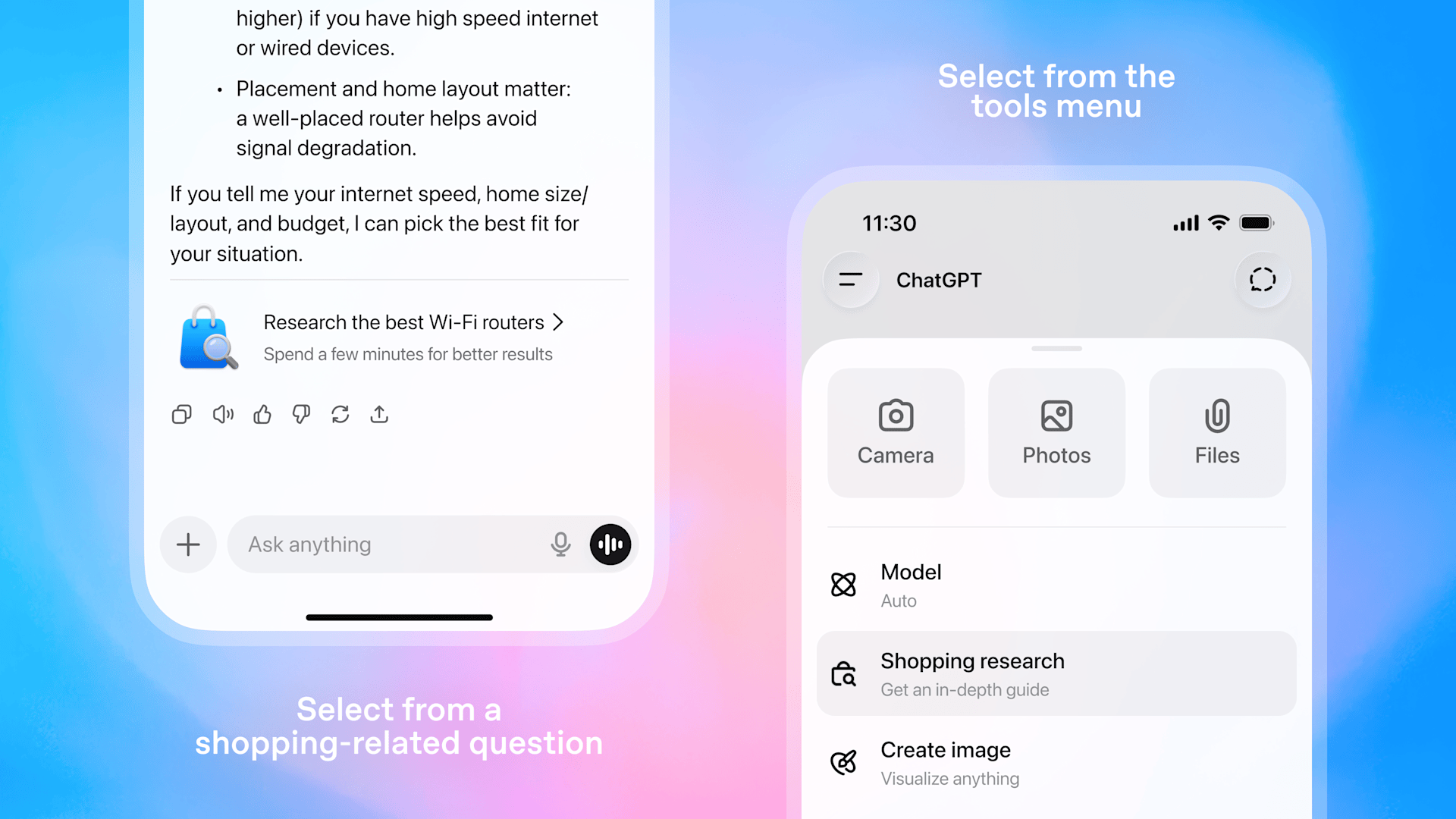
How a Purchase Happens
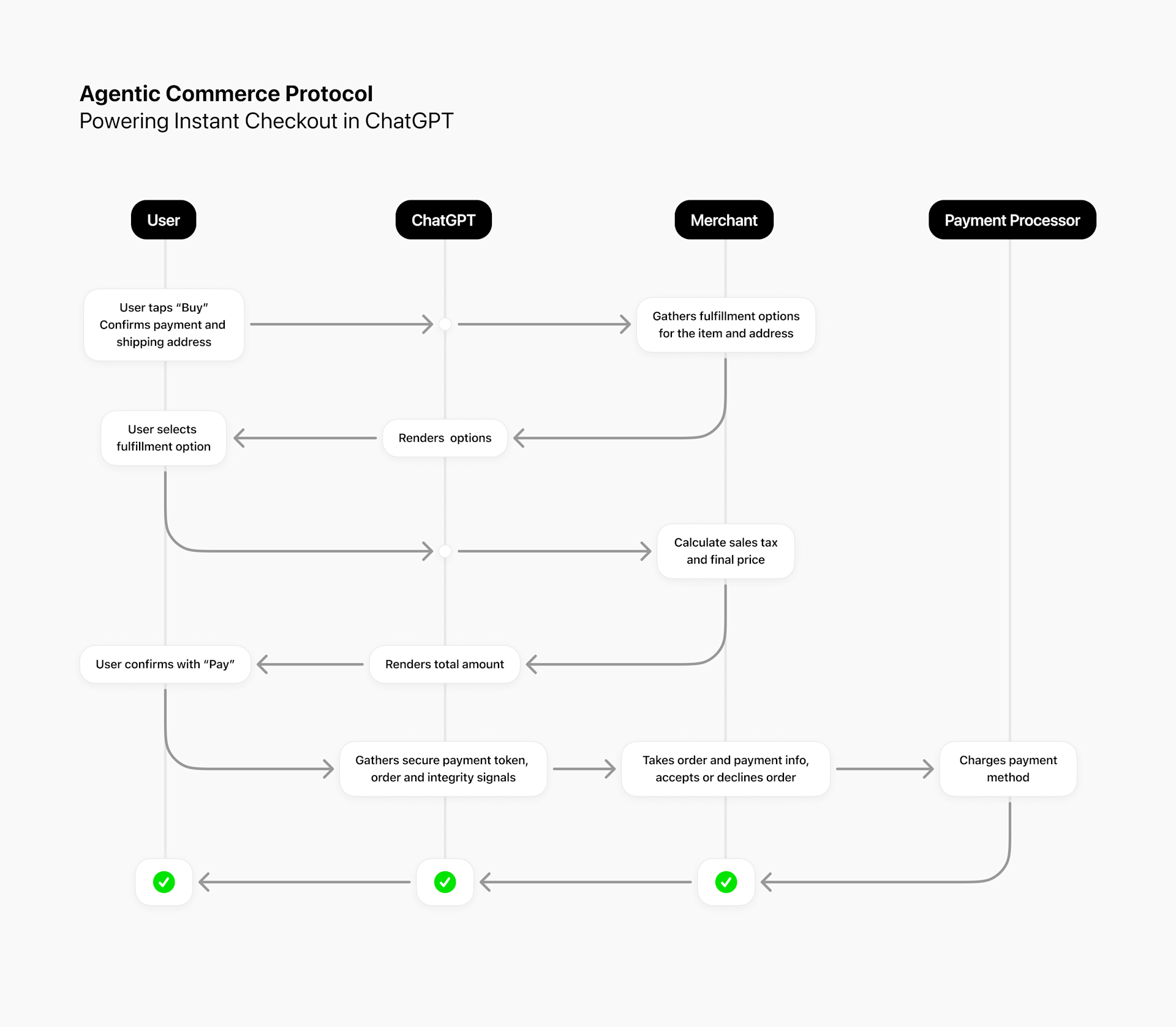
- A user asks ChatGPT for a product recommendation using natural language (“What’s the best waterproof hiking boot under $200?”)
- ChatGPT’s AI shopping assistant searches merchant product feeds to find relevant products
- Products appear in conversational results with personalized recommendations and a “Buy” button
- The user clicks Buy. Instant Checkout opens (no redirect to your site)
- Payment processes via Stripe using a Shared Payment Token (the agent never sees the card)
- Order is placed. The merchant fulfills and remains merchant of record
The user never leaves ChatGPT. There is no click-through to your website. The entire shopping journey and decision-making process happens inside the conversation.
Who’s Live Now
As of February 2026:
Etsy: US sellers are automatically included through Etsy’s Offsite Ads program. Live since September 2025.
Shopify: Merchant onboarding is underway. Brands like Glossier, SKIMS, Spanx, and Vuori were announced as early partners.
Instacart: Launched December 8, 2025 as the first grocery partner through the ChatGPT Apps integration.
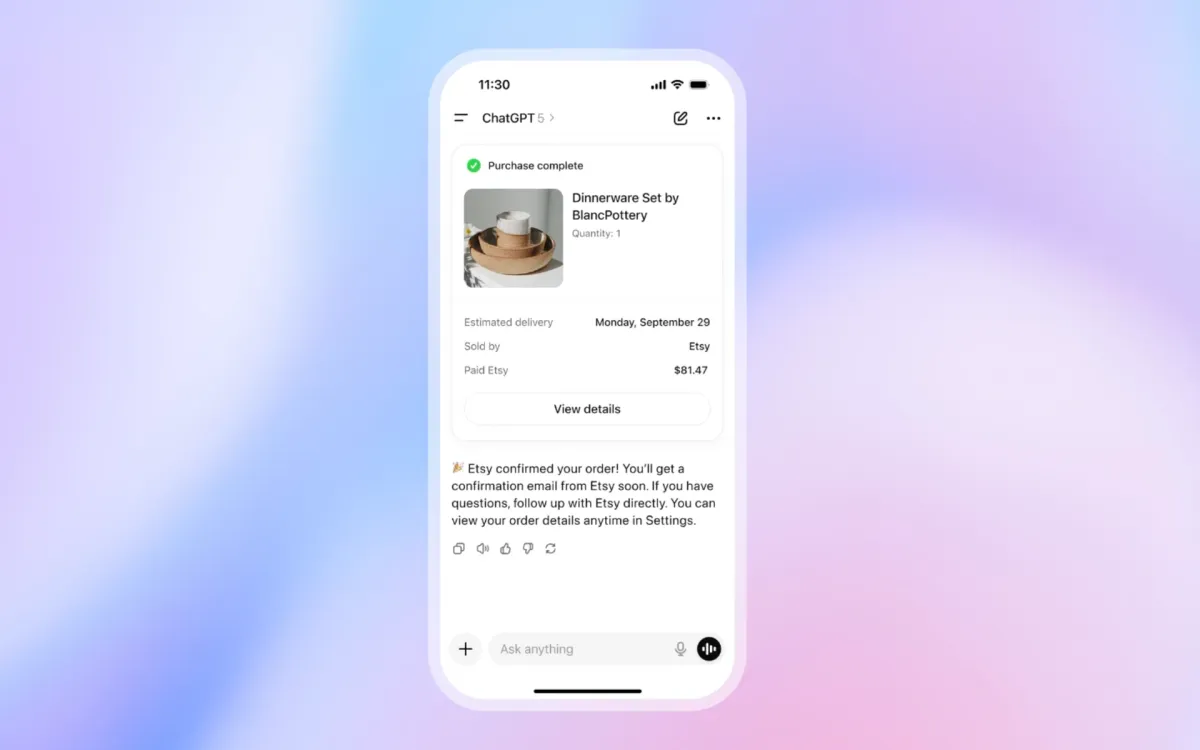
What It Costs
OpenAI charges merchants a 4% transaction fee on every completed Instant Checkout purchase (shoppers pay nothing extra). This was confirmed in late January 2026 when Shopify merchant onboarding began. The fee is in addition to standard payment processing (Stripe’s ~2.9% + $0.30).
For a $100 order, that’s $4.00 to OpenAI plus ~$3.20 to Stripe, about $7.20 in total platform and processing fees.
The Technical Architecture
ACP requires three components working together: a product feed, a checkout API, and a payment integration.
Product Feed: You push a gzip-compressed file (.jsonl.gz, .csv.gz, or .xml.gz) to an OpenAI-provided endpoint. Daily updates are accepted. The feed tells ChatGPT what you sell, what’s in stock, and what it costs, including complete product details like title (max 150 chars), description (max 5,000 chars), price with ISO 4217 currency code, availability status, images, and eligibility flags for search and checkout.
Checkout API: Five REST endpoints handle the purchase flow: create session, update session (shipping, variants), get state, complete purchase, and cancel. All responses return JSON with full checkout state including line items, totals, and shipping options.
Payment: If you use Stripe, enabling the Shared Payment Token is straightforward. Adyen is also referenced in the ACP spec, though Stripe is the primary integration partner. Adyen’s deeper agentic commerce role is through Google’s Agent Payments Protocol (AP2). For other payment processors, ACP offers a Delegated Payment Spec, though integration is more complex.
Platform Merchants: The Easy Path
If you’re on Shopify, you don’t build any of this. Shopify built the integration for your Shopify store. You apply at chatgpt.com/merchants, and once approved, enable it in your Shopify admin. Requirements: paid Shopify plan, Shopify Payments enabled, US-based.
If you’re on Etsy, you’re already live. US Etsy sellers are included automatically through the Offsite Ads program. No application needed.
What’s Coming in 2026
Multi-item carts (currently single-item only), PayPal integration (announced October 2025), international expansion, and additional merchant categories.
UCP Protocol: Google’s Universal Commerce Standard for AI Agents
The Basics
| Attribute | Details |
|---|---|
| Full name | Universal Commerce Protocol |
| Built by | Google + Shopify (primary co-developers) |
| Status | Announced January 11, 2026 at NRF |
| Reach | AI Mode in Google Search + Gemini app |
| Geography | US first, expansion TBD |
| Spec | ucp.dev |
The Coalition Behind It
UCP isn’t just Google. It launched with backing from a coalition that signals industry-wide alignment.
Co-developers who built the protocol: Google, Shopify, Etsy, Walmart, Target, and Wayfair. (Google and Shopify are the primary engineering leads; Shopify’s engineering blog describes the others as “supported by.”)
Endorsers (20+) across payments, retail, and technology: Adyen, American Express, Mastercard, PayPal, Stripe, Visa, Worldpay, Ant International, Best Buy, Carrefour, Chewy, Flipkart, Gap, Kroger, Lowe’s, Macy’s, Sephora, Shopee, The Home Depot, Ulta, Zalando, and Salesforce.
When Visa, Mastercard, Walmart, Target, and Stripe all endorse the same protocol, that’s not a press release. It’s a market signal.
Understanding Google’s Motives for UCP
To understand why Google built UCP, you have to understand what Google stands to lose: Google’s entire business model is built on owning the moment a person decides they want something. That moment, the so-called “high-intent query”, is what makes a search impression worth anything to an advertiser.
AI-first assistants like ChatGPT threaten to absorb that moment before the user ever reaches a search bar. If customers start asking ChatGPT “what’s the best running shoe under $150?” and checking out inside the conversation, Google does not just lose a click. It loses its position at the top of the commercial funnel, permanently.
UCP is Google’s answer: if commerce is going to happen inside AI interfaces, Google will build the infrastructure that makes it happen inside their AI interfaces. The coalition of Walmart, Target, Visa, Mastercard, Stripe and others is Google reconstructing the commercial internet around AI Mode and Gemini the same way it once reconstructed product discovery around Google Shopping. Brands that understand this are not just adopting a checkout protocol. They are picking a position in Google’s next decade of commerce infrastructure.
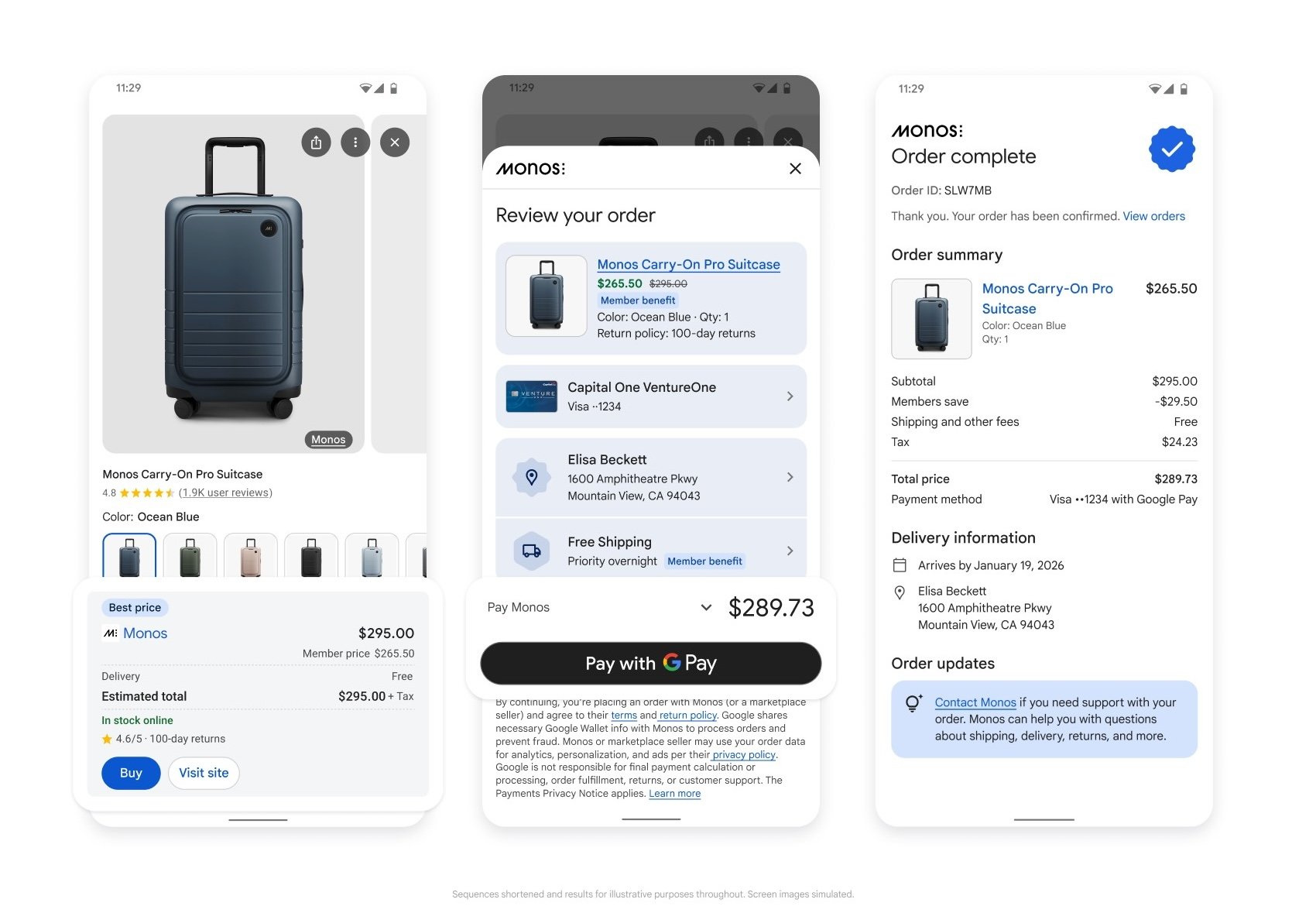
How a Purchase Happens
- A user queries Google Search in AI Mode or uses Gemini
- The AI agent searches UCP-enabled merchant catalogs
- Products surface with contextual recommendations
- The user initiates purchase (Native or Embedded checkout)
- Payment processes via Google Pay, PayPal, or other supported methods
- Merchant fulfills. Remains merchant of record and owns customer data
The Technical Architecture
UCP is more modular than ACP. Instead of a monolithic spec, it uses independently versioned “capabilities” under the dev.ucp.* namespace. The core functionality is organized so merchants declare which capabilities they support, and agents discover them through a /.well-known/ucp profile.
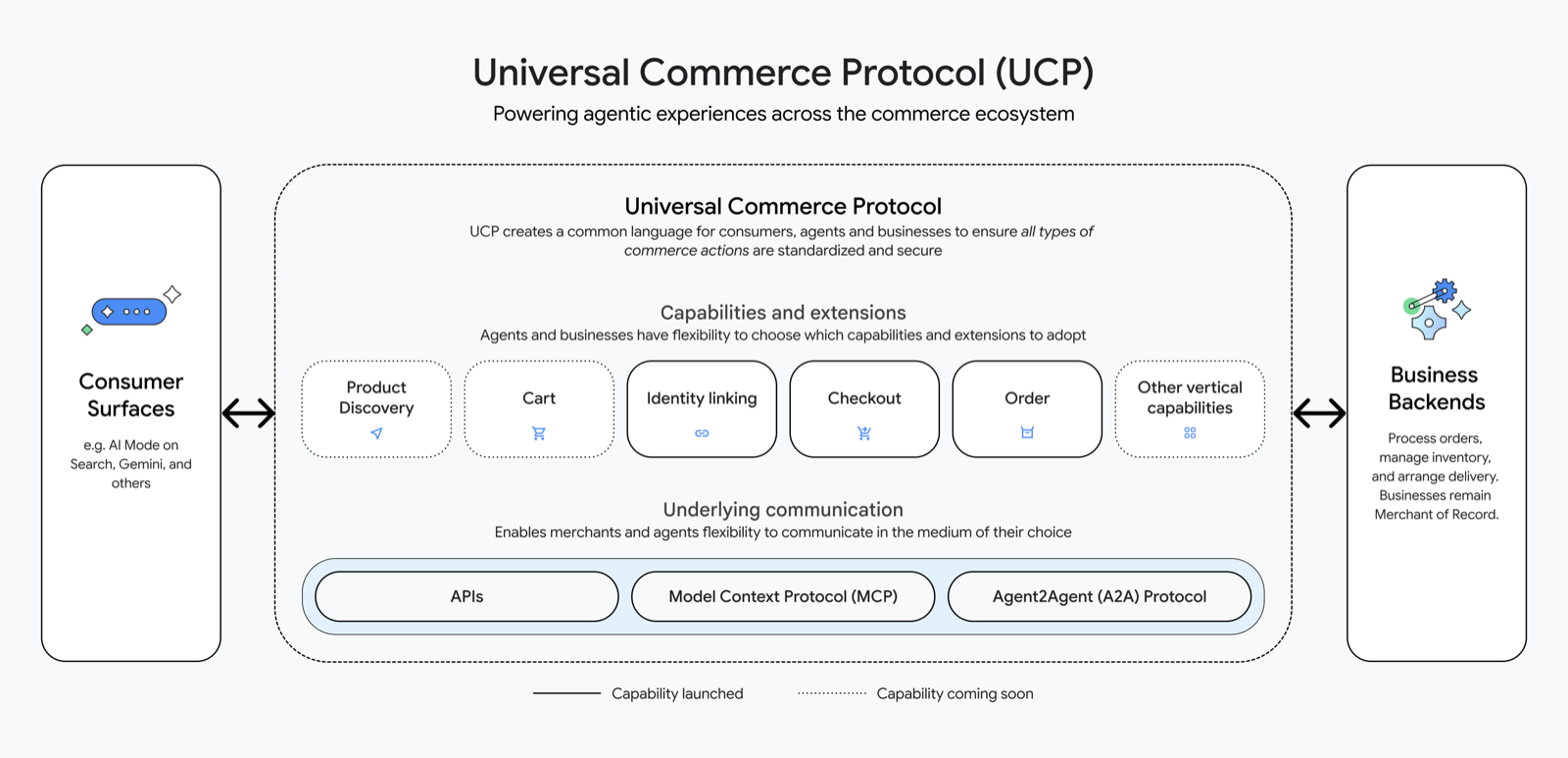
Three core capabilities at launch:
- Checkout: Payment processing, cart logic, tax calculations
- Identity Linking: OAuth 2.0-based secure agent-merchant relationships
- Order Management: Post-purchase operations, order tracking, returns, and status updates
Additional capabilities include fulfillment coordination, promotional pricing, payment authorization (AP2 Mandates), and buyer consent management. Loyalty and subscriptions are on the roadmap.
Transport bindings: UCP supports four ways for data to move between agents and merchants:
- REST: Standard HTTP API calls
- MCP: Anthropic’s Model Context Protocol (JSON-RPC)
- A2A: Google’s Agent2Agent protocol
- EP: Embedded Protocol for iframe-based checkout
This multi-transport design means UCP-enabled merchants can be discovered by agents beyond Google’s own, including those built on Anthropic’s Claude or other AI platforms. It’s designed to streamline customer interactions across any AI-powered shopping assistant, not just Google’s.
Checkout Options
Native Checkout (recommended): The purchase happens within Google’s AI surface. Lower friction, higher conversion potential. Requires implementing UCP’s checkout session API.
Embedded Checkout: An iframe loads the merchant’s own checkout UI inside the AI experience. More control over the branded experience, but higher friction.
How to Get Started
Shopify merchants: Your Shopify store is automatically included. Shopify is a coalition co-developer, and their Agentic Storefronts infrastructure handles UCP for you. No separate integration needed.
Everyone else: Whether you run a custom e-commerce store or another platform, you need a Google Merchant Center account with healthy shopping feeds (no disapprovals, complete attributes), and you join the waitlist at developers.google.com/merchant/ucp. No firm public launch date has been announced yet.
ACP vs UCP: Comparing AI Commerce Protocols
| Aspect | ACP (ChatGPT) | UCP (Google) |
|---|---|---|
| Status | Live (Sept 2025) | Announced (Jan 2026) |
| Primary surface | ChatGPT | Google Search AI Mode, Gemini |
| User base | 900M+ weekly users | Dominant search market share |
| Shopify support | Auto-eligible, apply at portal | Auto-included when live |
| Etsy support | Auto-included | Coalition member |
| Non-platform integration | Checkout API (5 endpoints) | Native Checkout API |
| Product feed | ACP Product Feed Spec | Google Merchant Center |
| Payment rails | Stripe primary; Adyen, others via Delegated Payment | Google Pay, PayPal, others via AP2 |
| Transaction fee | 4% (confirmed Jan 2026) | Details TBA as of Feb 2026 |
| Merchant of record | Merchant | Merchant |
| Open source | Yes (Apache 2.0) | Yes |
| Multi-item cart | Coming 2026 | Coming soon |
| International | US only (2026 expansion) | US first, TBD |
When to Prioritize Which
Start with ACP if you’re on Shopify or Etsy (near-zero effort), you already use Stripe, or you want to be live now rather than waiting.
Start with UCP if you have a strong Google Merchant Center presence, your customers are heavy Google Search users, or you’re already deep in the Google Shopping ecosystem.
Most brands will need both. The user bases are different. ChatGPT shopping is conversational discovery (“What’s the best trail running shoe under $150?”). Google AI Mode is intent-based discovery (“buy waterproof hiking boots size 10”). Different moments, different AI shopping assistants, same customer. Each delivers personalized experiences through different entry points in the online shopping journey.
This isn’t VHS vs Betamax. It’s Google Ads vs Meta Ads. Both survive. Both matter. And they’re not alone. Perplexity and Microsoft Copilot are also building shopping surfaces, each with their own user base. The real question is total market share of AI-mediated commerce, not which protocol wins.
Amazon and AI Shopping: Why They’re Building Separately
Amazon is conspicuously absent from both ACP and UCP. No endorsement. No partnership. No participation. For the company that controls 40% of US e-commerce, that silence is strategic. Brands need to understand what it means.
Amazon Is Building Its Own Path
Rufus AI is Amazon’s in-app shopping assistant. It has 300 million users, drives 60% higher conversion rates among active users, and generated an estimated $12 billion in incremental sales in 2025. Rufus recommends products, answers customer questions, and executes purchases, all within Amazon’s ecosystem.

Alexa+ (free for Prime members) adds agentic capabilities to voice commerce: it monitors prices, automatically purchases when thresholds hit, and executes multi-step tasks like restaurant booking and service scheduling.
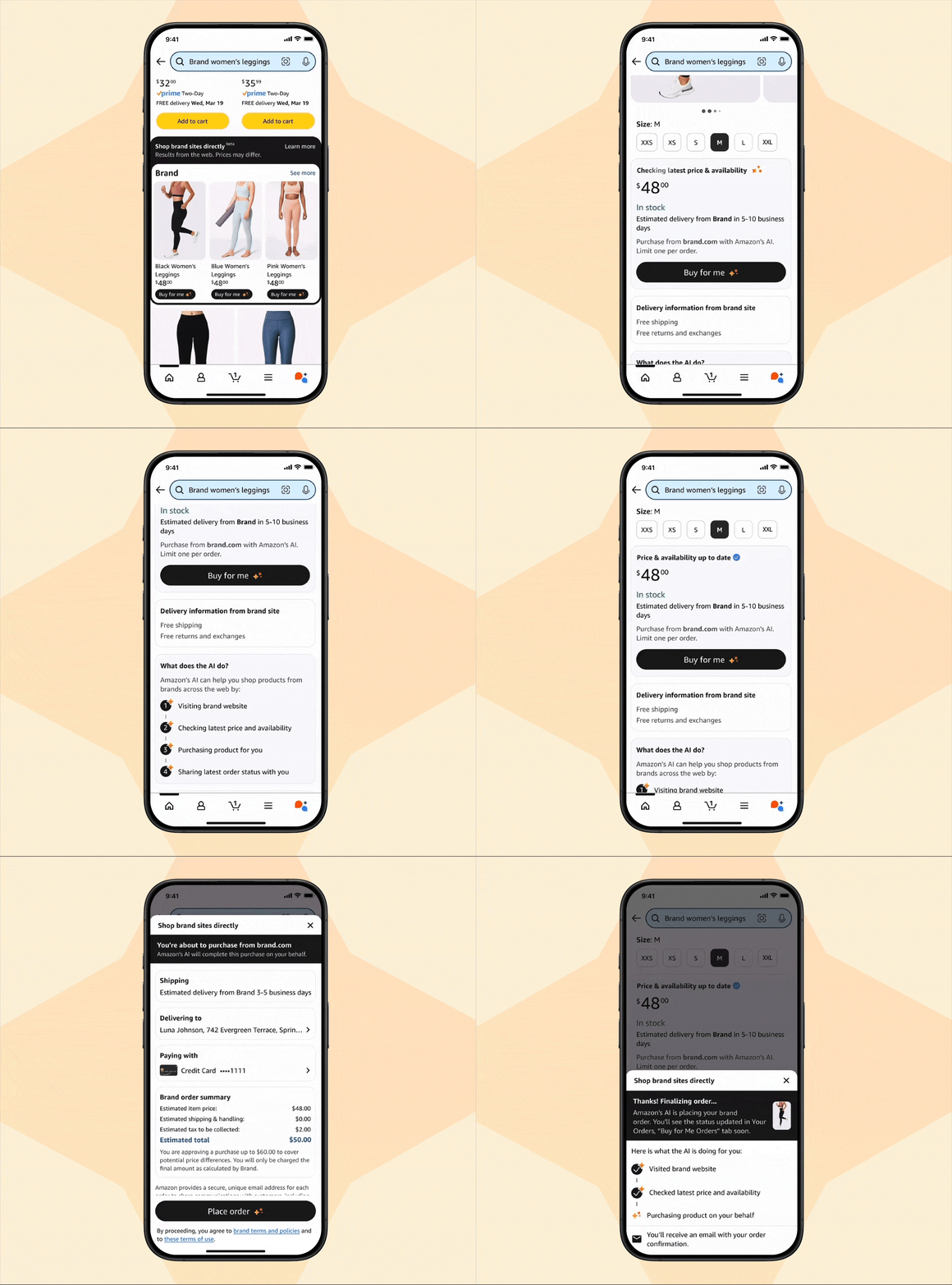
Buy for Me goes further. It lets customers purchase from competing retailers directly within Amazon’s app. Amazon scrapes competitor sites, acts as intermediary, and completes checkout using encrypted customer data. Amazon is building an agent that shops the entire web, but only on Amazon’s terms.

Why Amazon Won’t Join Open Protocols
UCP and ACP directly threaten Amazon’s core business model. Amazon’s profit depends on controlling the discovery moment: product rankings, sponsored placements, subtle algorithmic nudges toward higher-margin items. An open protocol where AI shopping assistants compare products across every online store turns Amazon into just another merchant behind an API. That’s an existential flattening of the leverage that makes Amazon dominant.
Amazon has responded accordingly. It updated its robots.txt to block OpenAI’s crawlers, removing 600 million products from ChatGPT’s shopping results. It updated its legal terms to block AI agent behavior. It sued Perplexity for unauthorized purchases. The walled garden is getting taller.
What This Means for Your Brand
You now face a three-ecosystem world:
- Amazon’s proprietary agents (Rufus, Buy for Me, Alexa+): massive reach, closed system
- Google’s UCP (partnered with Walmart, Target, Shopify, Etsy, and 20+ others): open protocol, intent-based discovery
- OpenAI’s ACP (ChatGPT Instant Checkout via Stripe): open protocol, conversational discovery
If you’re Amazon-first: Optimize for Rufus, not external agents. Focus on reviews, Q&A, and pricing competitiveness within Amazon’s walled garden. Watch for Amazon eventually offering partnership APIs. CEO Andy Jassy has signaled openness to “partnerships” with third-party agents, but on Amazon’s terms.
If you’re multi-channel: Prepare to maintain product data for three separate agent ecosystems. The feed structures differ. The checkout flows differ. The attribution models differ. This is the cost of omnichannel in 2026.
If you’re DTC: UCP and ACP may let you bypass Amazon entirely. If AI-powered shopping assistants can route high-intent customers directly to your checkout, you reduce your dependence on Amazon’s marketplace (and its commission structure). But your product data, schema markup, and checkout infrastructure need to be flawless.
The strategic bet: Walmart is betting on openness (UCP partnership). Amazon is betting on control (proprietary agents). One of them is right. Either way, your brand needs to be visible to all three ecosystems.
AI Commerce Attribution: Tracking Sales from ChatGPT and AI Agents
Here’s the uncomfortable truth about agentic commerce in early 2026: you can sell through it, but you can’t fully measure it. Your analytics stack was built for a world where customers click links, visit pages, and generate session data. AI-mediated purchases break every one of those assumptions. The customer behavior that drives the sale is invisible to your existing tools.
What You Can’t See
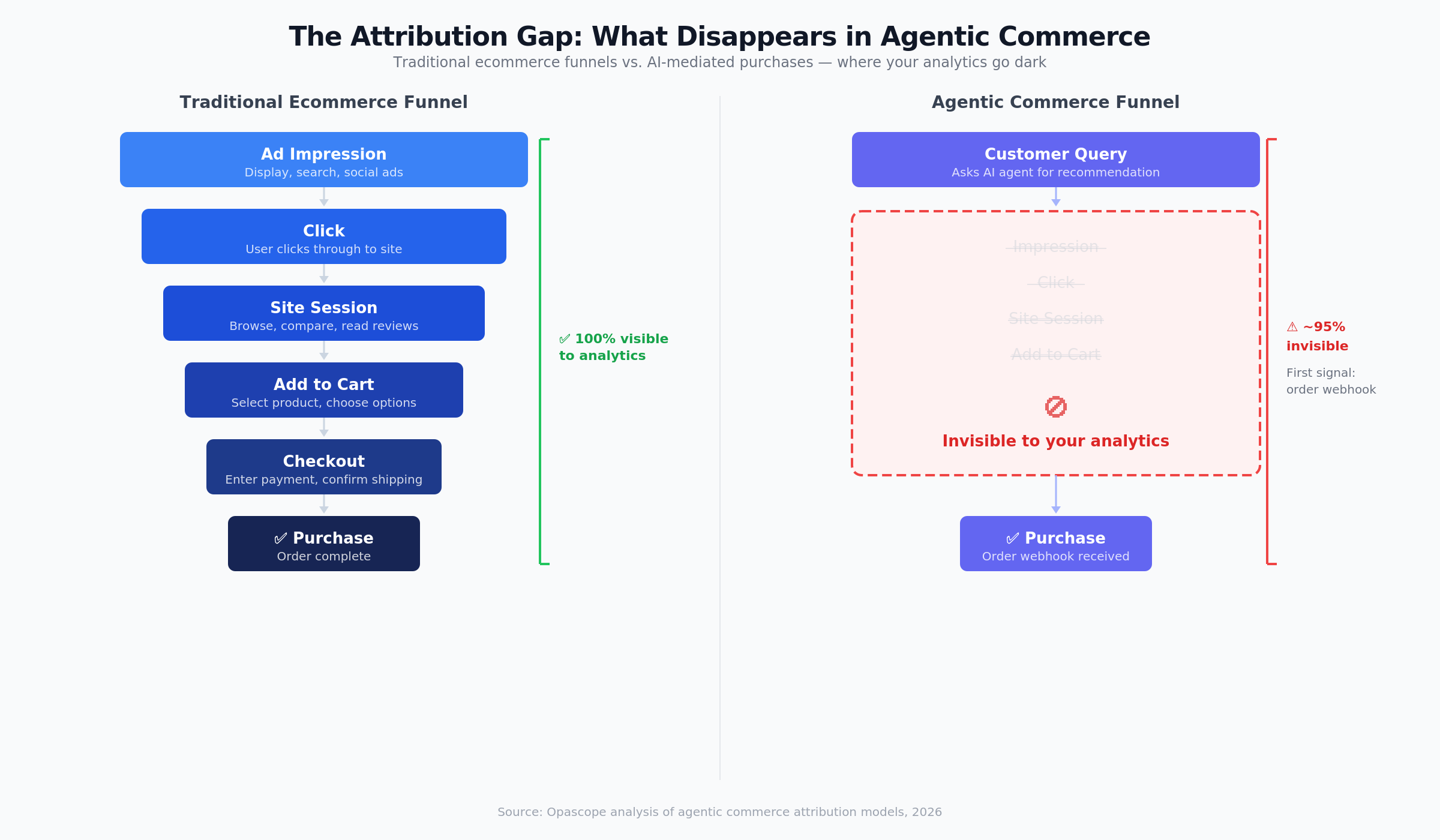
When a customer asks ChatGPT about your product category, the AI shopping assistant compares options, uses natural language processing to understand intent, makes a recommendation, and the customer checks out, all inside the chat. Your analytics platform sees none of it. No impression. No click. No session. No add-to-cart event. The customer interactions with the agent are completely invisible to you. The first signal you get is an order webhook.
That means you can’t answer basic questions: How many times was your product recommended? Which competitors was it compared against? What influenced the agent’s decision-making? Did the customer consider your brand and reject it?
Research suggests 70–90% of the shopping journey now happens before any trackable interaction. With agentic commerce, that figure approaches 100%.
What You Can See
It’s not a total blackout. The webhook data from ACP and UCP tells you what was sold, when, the order value, and which agent platform facilitated the purchase. Shopify’s Agentic Storefronts provide channel attribution in the admin. You can see whether an order came from ChatGPT, Microsoft Copilot, or Perplexity.
But there’s a chasm between “we know a sale happened” and “we understand why it happened and whether it was incremental.”
Why This Is Harder Than Podcasts
Podcast attribution faced a similar “dark funnel” problem. But podcasts at least gave brands promo codes and a measurement window of days to weeks. Agentic commerce happens in seconds, with one-click checkout that removes every identity-capture mechanism. The customer barely perceives the AI as an intermediary. They just think they decided to buy something.
Podcast attribution took five years to mature. Agentic commerce measurement is even harder, and the tools are earlier stage.
What to Do Now
Server-side tracking is non-negotiable. If you don’t have webhook infrastructure to capture ACP/UCP order events and route them to your analytics platform (GA4, Segment, a data warehouse), you’re flying blind. Set this up before you optimize anything else. Tools like Tealium already support ACP webhook ingestion.
Run incrementality tests. Attribution asks “what fraction of revenue do I credit to this channel?” Incrementality asks “how much additional revenue did this channel actually create?” The second question matters more. Approaches include geographic holdouts (disable agentic checkout in 5–10% of markets for 8–12 weeks), temporal holdouts (disable for random 24-hour windows), or cohort comparisons. Google lowered its incrementality testing threshold to $5,000 in late 2025, making this accessible to smaller brands.
Track discovery, not just conversion rates. Tools like Stackline’s AI Visibility product track how often your products appear in AI responses and how you compare to competitors. This is the agentic equivalent of impression share, similar to what we measure in AI search optimization. If you’re invisible to agents, conversions are a moot point.
Invest in product data quality above all else. In a channel where you can’t outspend competitors on ads, the quality of your structured data (descriptions, attributes, reviews, images) is your primary lever for agent recommendations. Merchants with 95%+ data fill rates on core attributes see dramatically higher AI agent visibility. The agents need rich product details and complete product catalogs to surface the right product for each customer query.
Move fast. There is a factor that does not appear in any feed spec or schema guide, but which will increasingly determine who AI agents recommend: how long your products have been cited across AI-indexed sources.
AI shopping assistants do not treat all structured data as equal. Sources that have been consistently referenced, linked, and validated over time carry more weight than a newly optimized feed, regardless of how technically complete that feed is. This is called “citation age”, the AI equivalent of domain authority in traditional SEO.
In most product categories, the citation landscape is still sparse. Unlike Google Search, where established competitors have years of backlink equity, AI product citations are still being built. A brand that earns consistent citations in AI responses this year, through product reviews, editorial coverage, and structured data that gets repeatedly indexed, establishes a compounding advantage that will be extremely difficult for late movers to close. The window to become the default recommendation in your category is not permanently open.
Plan for 18–24 months before you have high-confidence attribution. By late 2026 or early 2027, measurement frameworks will start to mature. The retailers who invested in infrastructure now will have the data to prove ROI. Those who waited will be guessing.
Implementation Playbook: Getting Started with AI Shopping Assistants
If You’re on Shopify (US)
Effort: Minimal. Configuration, not engineering.
For ACP (ChatGPT):
- Confirm your Shopify store is on a paid plan with Shopify Payments enabled
- Apply at chatgpt.com/merchants with your store URL, business contact, product categories, and estimated monthly order volume
- Once approved, enable the ChatGPT sales channel in your Shopify admin
- Automate webhook ingestion to track orders server-side
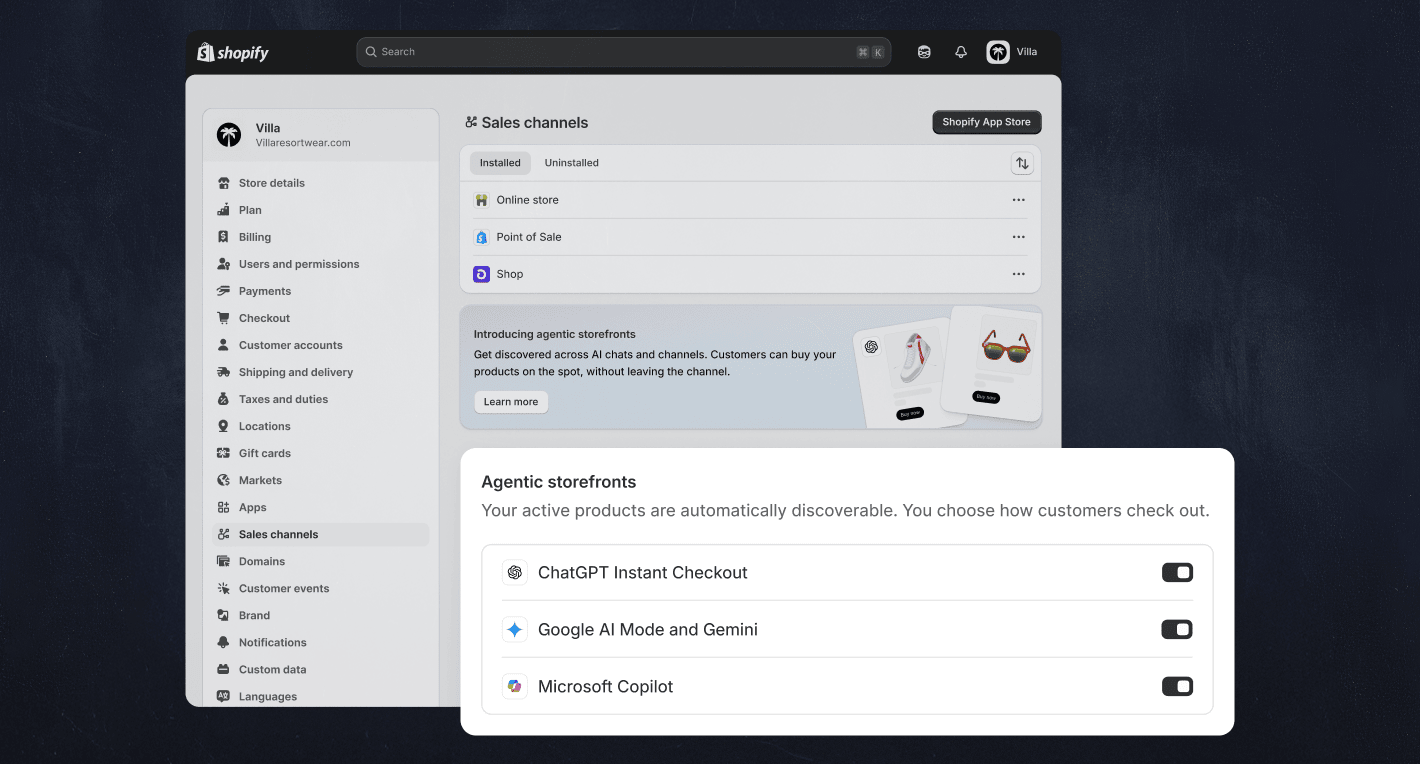
For UCP (Google): Nothing to do. Shopify’s Agentic Storefronts handle UCP automatically when it launches. Make sure your Google Merchant Center account is healthy: no disapproved products, no policy violations, feeds updated within 24 hours. This streamlines the entire setup for Shopify store owners.
If You’re on Etsy (US)
For ACP (ChatGPT): You’re already live. US Etsy sellers are included automatically through the Offsite Ads program. Verify by asking ChatGPT to search for products in your category.
For UCP (Google): Etsy is a coalition co-developer. Likely automatic when UCP goes live. Monitor for announcements.
For Everyone: Optimize Your Product Data
Whether you run an online store on Shopify, Etsy, or a custom platform, the quality of your product data determines how AI agents discover and recommend you. This is the most impactful work you can do right now to improve customer satisfaction and drive sales through AI shopping assistants.
Audit your product feed:
| Field | What to Check | Common Problems |
|---|---|---|
| Title | Under 150 chars, descriptive, natural language | Too short, keyword-stuffed |
| Description | Use-case driven, answering questions customers actually ask | Marketing fluff, no specifications |
| Price | Accurate, matches live site price | Stale data, currency issues |
| Availability | Real-time sync with inventory | Shows in-stock when sold out |
| Images | High-resolution, clean backgrounds | Low quality, lifestyle-only |
| GTIN/UPC | Present and valid | Missing or incorrect |
| Category | Google Product Category, 5 levels deep | Too shallow, wrong category |
Write descriptions for AI, not SEO crawlers. AI agents use natural language processing to match natural language queries to relevant products. A title like “Men’s Trail Running Shoe – Blue – Size 10” gives an agent nothing to work with. A description like “Lightweight trail running shoe designed for technical terrain. Breathable mesh upper keeps feet cool on long runs. Aggressive lug pattern provides grip on loose rock and mud. Weighs 8.5 oz. Best for: trail races, mountain running, fast hiking.” gives the agent everything it needs to match the right product to a user’s intent.
Audit your schema markup. Run your product pages through Google’s Rich Results Test. Every product page should have valid Product, Offer, and AggregateRating schema. Prices must match displayed prices. Availability must update dynamically.
Clean up Google Merchant Center. For UCP readiness, you need zero disapproved products, no policy violations, feeds updated within 24 hours, automatic item updates enabled, and free listings turned on. Google supports 170 product attributes. The more you complete, the richer your signal to AI agents.
The Great Risk Of Bad Data Quality Nobody Is Talking About
Data quality is usually classified as a ranking factor: incomplete titles, shallow categories, and low-resolution images make you less likely to surface in agent results. That’s true. But it misses an equally, if not more important reason to make product data hygiene a top priority.
When an AI agent initiates a checkout session against your feed and the price no longer matches your live site, you will either sell below price or really annoy your customer. The transaction might even fail completely. Or when availability shows in_stock for a variant that sold out three days ago, the agent may attempt to complete the purchase, hit a wall, and either surface an error to the customer or quietly deprioritize your product in future sessions.
Unlike a website visitor who sees a “sold out” banner and understands the situation, an AI agent has no tolerance for inconsistency. It simply moves on to the next result.
Bad data, in the context of agentic commerce, is therefore not just a ranking problem. It is a revenue problem, especially since it affects your most valuable group: Customers who have already decided to buy.
If You Need a Custom Integration
If you’re not on Shopify or Etsy and want ACP integration, this is a development project. You’ll need to build three things: a product feed endpoint serving data per the ACP spec (daily updates to an OpenAI-provided endpoint), a Checkout API implementing five REST endpoints, and a Stripe integration using Shared Payment Tokens. OpenAI runs conformance tests before approval covering feed validation, checkout flow testing, and payment processing. You’ll also want to automate feed updates so your product catalog stays in sync with your inventory in real-time.
For UCP, you’ll need an active Google Merchant Center account with healthy feeds, a capability profile published at /.well-known/ucp declaring your supported capabilities, and either a Native Checkout or Embedded Checkout implementation. Make sure the integration fits into your existing fulfillment and ecommerce workflows.
The build-vs-partner decision depends on your development resources, timeline flexibility, and whether you need custom requirements. If speed matters and you have a standard implementation, partnering with an agency that’s already built these integrations will save months.
Agentic Commerce Is Infrastructure First
The first instinct for most ecommerce businesses encountering a new digital channel is to produce content for it, from blog posts to buying guides and category pages. All designed to attract and educate. The world of agentic commerce, however, sets different priorities.
When being prompted to surface shopping results, AI shopping agents do not need editorial content. They need structured data. They evaluate feeds. They execute against APIs. A detailed article about your product category will not improve your ranking in a ChatGPT shopping result as much as a complete, accurate, real-time product feed will.
This is a fundamental inversion of the traditional content-first acquisition model, and it has direct implications for where ecommerce brands should allocate resources in 2026.
The work that matters is not top-of-funnel content. It is the infrastructure that sits at the bottom of the funnel: product data completeness, schema markup, feed hygiene, checkout API reliability, and server-side tracking.
For brands that have spent years optimising blog content and organic search traffic, this requires a genuine reorientation. The channel rewards operational rigour over editorial volume. The brands that treat it as mainly a content problem will consistently lose to those that treat it primarily as an infrastructure problem.
Technical Reference: ACP Feed Spec, Checkout API, and Schema Markup
ACP Product Feed: Required Fields
Every product in your ACP feed must include these fields. Missing any of them will cause feed validation failures.
Core required fields:
| Field | Type | Description |
|---|---|---|
item_id |
string | Unique identifier (max 100 chars, must remain stable) |
title |
string | Product name (max 150 chars) |
description |
string | Full description (max 5,000 chars) |
url |
string | Product page URL (must resolve HTTP 200) |
price |
number + currency | Price with ISO 4217 currency code |
availability |
enum | in_stock, out_of_stock, pre_order, backorder, unknown |
image_url |
URL | Main image (JPEG/PNG preferred) |
brand |
string | Brand name (max 70 chars) |
Additional required fields:
| Field | Type | Description |
|---|---|---|
is_eligible_search |
boolean | Controls whether the product appears in ChatGPT search results |
is_eligible_checkout |
boolean | Allows direct purchase inside ChatGPT (requires is_eligible_search = true) |
store_name |
string | Seller display name (max 70 chars) |
seller_url |
URL | Merchant website |
seller_privacy_policy |
URL | Required if checkout-eligible |
seller_tos |
URL | Required if checkout-eligible |
group_id |
string | Product group ID (max 70 chars) |
listing_has_variations |
boolean | Whether the listing has size/color/other variations |
target_countries |
list | Target country codes (required) |
store_country |
string | Country where the store is based (required) |
return_policy |
URL | Return policy page |
return_window |
integer | Days allowed for returns |
Optional fields (improve relevance and ranking): gtin (UPC/EAN/ISBN), mpn (manufacturer part number), material, weight, sale_price, additional_image_urls, color, size, gender, age_group, condition, product_category, shipping_price.
ACP Product Feed Example
A representative product object showing key feed fields. The actual feed format is flat JSONL (.jsonl.gz), CSV (.csv.gz), or XML (.xml.gz) with one row per variant:
{
  "item_id": "SKU-12345",
  "is_eligible_search": true,
  "is_eligible_checkout": true,
  "title": "Waterproof Hiking Boot - Men's",
  "description": "Full-grain leather hiking boot built for rugged trails. Gore-Tex waterproof membrane keeps feet dry in rain and stream crossings. Vibram Megagrip outsole provides superior traction on wet rock. EVA midsole cushions impact on long descents. Weight: 2.1 lbs per pair. Best for: day hikes, backpacking, scrambling.",
  "url": "https://example.com/products/hiking-boot-mens",
  "price": "189.00 USD",
  "sale_price": "159.00 USD",
  "availability": "in_stock",
  "image_url": "https://example.com/images/hiking-boot-main.jpg",
  "brand": "TrailMaster",
  "gtin": "012345678901",
  "product_category": "Apparel & Accessories > Shoes > Athletic Shoes > Hiking Shoes",
  "group_id": "SKU-12345",
  "listing_has_variations": true,
  "size": "9",
  "return_policy": "https://example.com/returns",
  "return_window": 60,
  "material": "Full-grain leather, Gore-Tex membrane",
  "color": "Brown",
  "store_name": "Example Outdoor Store",
  "seller_url": "https://example.com",
  "seller_privacy_policy": "https://example.com/privacy",
  "seller_tos": "https://example.com/terms",
  "target_countries": ["US"],
  "store_country": "US"
}
ACP Checkout API Endpoints
| Endpoint | Method | Purpose |
|---|---|---|
/checkout_sessions |
POST | Create checkout session |
/checkout_sessions/{id} |
POST | Update checkout (shipping, variants) |
/checkout_sessions/{id} |
GET | Get current checkout state |
/checkout_sessions/{id}/complete |
POST | Complete the purchase |
/checkout_sessions/{id}/cancel |
POST | Cancel checkout session |
Stripe Shared Payment Token Flow
// The AI agent creates a shared payment token via Stripe
// and passes the granted token to your API.
// You attach it to your PaymentIntent:
const paymentIntent = await stripe.paymentIntents.create({
  amount: totalAmount,
  currency: 'usd',
  shared_payment_granted_token: sharedPaymentGrantedToken,
  confirm: true
});
Schema Markup: Product JSON-LD Example
Place this in the of every product page. This is what AI agents and Google’s systems use to understand your product data directly from your site:
<script type="application/ld+json">
{
  "@context": "https://schema.org",
  "@type": "Product",
  "name": "Waterproof Hiking Boot - Men's",
  "image": [
    "https://example.com/images/hiking-boot-main.jpg",
    "https://example.com/images/hiking-boot-sole.jpg"
  ],
  "description": "Full-grain leather hiking boot built for rugged trails. Gore-Tex waterproof membrane keeps feet dry. Vibram Megagrip outsole for superior traction.",
  "sku": "SKU-12345",
  "gtin13": "0012345678901",
  "brand": {
    "@type": "Brand",
    "name": "TrailMaster"
  },
  "category": "Hiking Shoes",
  "material": "Full-grain leather, Gore-Tex membrane",
  "color": "Brown",
  "offers": {
    "@type": "Offer",
    "url": "https://example.com/products/hiking-boot-mens",
    "priceCurrency": "USD",
    "price": "159.00",
    "priceValidUntil": "2026-03-01",
    "availability": "https://schema.org/InStock",
    "itemCondition": "https://schema.org/NewCondition",
    "seller": {
      "@type": "Organization",
      "name": "Example Outdoor Store"
    },
    "shippingDetails": {
      "@type": "OfferShippingDetails",
      "shippingRate": {
        "@type": "MonetaryAmount",
        "value": "0",
        "currency": "USD"
      },
      "deliveryTime": {
        "@type": "ShippingDeliveryTime",
        "handlingTime": {
          "@type": "QuantitativeValue",
          "minValue": 1,
          "maxValue": 2,
          "unitCode": "DAY"
        },
        "transitTime": {
          "@type": "QuantitativeValue",
          "minValue": 5,
          "maxValue": 7,
          "unitCode": "DAY"
        }
      },
      "shippingDestination": {
        "@type": "DefinedRegion",
        "addressCountry": "US"
      }
    },
    "hasMerchantReturnPolicy": {
      "@type": "MerchantReturnPolicy",
      "applicableCountry": "US",
      "returnPolicyCategory": "https://schema.org/MerchantReturnFiniteReturnWindow",
      "merchantReturnDays": 60,
      "returnMethod": "https://schema.org/ReturnByMail",
      "returnFees": "https://schema.org/FreeReturn"
    }
  },
  "aggregateRating": {
    "@type": "AggregateRating",
    "ratingValue": "4.6",
    "reviewCount": "127"
  }
}
</script>
For products with size or color variants, use the ProductGroup schema type with hasVariant arrays. See the full spec at schema.org/ProductGroup.
Further Implementation References
For developers building custom integrations, these specs contain the full request/response examples and field-level documentation:
- ACP Checkout API (full request/response JSON for all 5 endpoints): developers.openai.com/commerce/specs/checkout
- ACP Product Feed Spec (complete field reference): developers.openai.com/commerce/specs/feed
- Google Merchant Center Attributes (170+ product attributes with format requirements): support.google.com/merchants
- UCP Capability Spec (checkout session API, identity linking, order management): ucp.dev
Glossary
| Term | Definition |
|---|---|
| ACP | Agentic Commerce Protocol. OpenAI/Stripe’s standard for AI commerce. |
| UCP | Universal Commerce Protocol. Google coalition’s standard for AI commerce. |
| A2A | Agent2Agent. Google’s protocol for agents to communicate with each other. |
| AP2 | Agent Payments Protocol. Standard for agents to process payments with cryptographic proof of user consent. |
| MCP | Model Context Protocol. Anthropic’s standard for giving AI models context. |
| SPT | Shared Payment Token. Stripe’s mechanism for agents to process payments without seeing card details. |
| GMC | Google Merchant Center. Google’s platform for managing shopping feeds. |
| Native Checkout | UCP integration where checkout happens within the AI surface. |
| Embedded Checkout | UCP integration using an iframe to the merchant’s checkout. |
| Instant Checkout | ChatGPT’s in-chat purchasing feature. |
Sources
Official Documentation
- OpenAI Commerce Developers
- ACP Product Feed Spec
- ACP Checkout Spec
- ChatGPT Merchants Portal
- Agentic Commerce Protocol
- Google UCP Developer Docs
- UCP Spec
- Shopify UCP Engineering
- Google Merchant Center Help
Announcements & Coverage
- OpenAI: Buy it in ChatGPT
- Stripe: OpenAI Instant Checkout
- PayPal-OpenAI Partnership
- Google Blog: Agentic Commerce
- TechCrunch: Google UCP Announcement
- PYMNTS: Shopify Merchants to Pay 4% Fee
Research & Analysis
- McKinsey: Agentic Commerce Forecast
- Morgan Stanley: Agentic Commerce Market Impact
- Forrester: 2026 B2B Predictions
- BCG: Agentic Commerce is Redefining Retail
Amazon & Attribution
- Amazon blocks ChatGPT shopping agent | TechRadar
- Amazon faces a dilemma: fight AI shopping agents or join them | CNBC
- Brandlight: The New Dark Funnel: How LLMs Are Hiding Your Customers’ Journey
- Tealium: Agentic Commerce and Server-Side Tracking
- IAB: Guidelines for Incremental Measurement in Commerce Media
Payment Platforms
FAQs
What is agentic commerce?
Agentic commerce is a new ecommerce sales channel where AI agents like ChatGPT and Google’s Gemini can discover products, compare options, and complete purchases on behalf of users, all within the AI interface. Two protocols enable this: OpenAI’s ACP (Agentic Commerce Protocol) and Google’s UCP (Universal Commerce Protocol). Unlike traditional chatbots that only answer basic customer queries, these AI-powered agents handle the entire transaction from product discovery to checkout.
How does ChatGPT Instant Checkout work?
ChatGPT Instant Checkout lets users buy products directly within ChatGPT conversations. When a user asks for product recommendations, the AI shopping assistant searches merchant product feeds, displays results with a Buy button, and processes payment via Stripe, without redirecting to the merchant’s website. It uses artificial intelligence and natural language processing to understand what the customer wants and surface relevant products from its product catalog.
What is the difference between ACP and UCP?
ACP (Agentic Commerce Protocol) is OpenAI and Stripe’s protocol, live since September 2025 in ChatGPT. UCP (Universal Commerce Protocol) is Google’s coalition-backed protocol announced January 2026, coming to Google Search AI Mode and Gemini. Most brands will need to support both protocols. ACP excels at conversational product discovery, while UCP captures high-intent search queries. Different use cases, but both critical for ecommerce brands.
How much does ChatGPT Instant Checkout cost retailers?
OpenAI charges merchants a 4% transaction fee on every completed Instant Checkout purchase (shoppers pay nothing extra), in addition to standard payment processing fees (Stripe’s ~2.9% + $0.30). For a $100 order, total platform and processing fees are approximately $7.20. There are no upfront costs or monthly fees; pricing is purely transaction-based.
Is Amazon part of agentic commerce protocols?
No. Amazon has not joined ACP or UCP. Instead, Amazon is building proprietary AI shopping agents (Rufus AI, Alexa+, Buy for Me) within its own ecosystem. Brands now face a three-ecosystem world: Amazon’s proprietary agents, Google’s UCP, and OpenAI’s ACP.
How do brands get their products to show up in AI shopping assistants?
For ChatGPT (ACP), Shopify merchants can enable the ChatGPT sales channel directly from their Shopify admin. It takes minutes and requires no code. Non-Shopify merchants need to integrate with Stripe and build an ACP-compliant product feed. For Google (UCP), the protocol is still in developer preview, but brands should start by ensuring their product data is structured with complete schema markup, clean Google Merchant Center feeds, and detailed product attributes. The brands with the most complete, well-structured product data will be the ones AI agents surface first.
What’s Next
AI shopping assistants are a new sales channel. Not a future one, a current one. The brands that invest in structured product data, protocol readiness, and measurement infrastructure now will have a meaningful advantage as this ecommerce channel scales.
The brands that wait will be optimizing their product feeds for AI agents in 2027, watching competitors who started in 2026 collect the early data, the early customer relationships, and the early learnings.
Need help preparing your product catalog for AI agents? Whether it’s feed optimization, schema markup, ACP/UCP integration, or building a measurement framework for agentic commerce, get in touch with Opascope. We specialize in AI search optimization and GEO/AEO services for e-commerce brands, and we can help you move fast without building from scratch. See our case studies for examples of how we’ve helped brands improve visibility.
Published by Opascope | February 2026