


Reading time
25 mins
Last updated
Nov 16, 2026
For many years, digital marketing evolved at a steady pace. Paid search on Google Ads, paid social on Facebook, Instagram and LinkedIn, and organic search on Google progressed year after year, as marketers refined the targeting, content and measurement on the same channels. This changed dramatically throughout 2026.
In 2026, large language models (LLMs) like ChatGPT and Gemini, and Google’s AI Overviews, broke that pattern with a dramatic shift in how people find and use information on the web. About half of U.S. adults1 reported using AI chatbots in Pew Research Center’s 2026 survey, up from a third in 2024, and a McKinsey survey of about 21,000 consumers in 11 markets, reported in October 20262, found that 53% now use AI for shopping.
That dramatic shift has created an entirely new industry called answer engine optimization (AEO), sometimes referred to as generative engine optimization (GEO). The industry conveniently swapped out one letter in SEO to make a familiar acronym and basically said:
“AEO is like search engine optimization, but just for ChatGPT and Gemini.”
– Everyone
Most brands and agencies arrived at AEO carrying decades of search habits. Keyword targeting, on-page content, link building and rank tracking had become second nature, so when LLMs such as ChatGPT took off, teams used SEO as the foundation and went looking for the places where AEO matched it or departed from it. That stored inertia forced apples-to-apples comparisons between two things that are apples and oranges.
The future of AEO starts with redefining those old habits, keyword targeting and on-page content included, and looking at how an LLM reaches a decision. An LLM weighs a set of factors called determinants before it recommends a brand, and the sections below cover what determinants are and what a brand can do about each one.
AEO Determinants: The Future of Organic Optimization
The future of organic optimization is determinants, the decision-making criteria an LLM uses to bring someone through to a decision. Optimizing through determinants targets the core concepts LLMs value, and those concepts match the psychology of how buyers decide. Determinants are also what the LLMs are optimizing for. Each advance in the technology is built to understand people more closely, which makes the determinants the most accurate focus for AEO. Optimizing around the determinants starts with understanding what a determinant is.
What Is a Determinant?
The Oxford dictionary defines a determinant as:
determinant noun
a thing that decides whether or how something happens3
To understand how determinants affect a brand’s visibility on LLMs, consider someone shopping online for a flat-screen TV. Before the shopper opens a single listing, a set of things is already going to decide the purchase. Those things include who will watch it, the room it goes in, what it will mostly be used for, what the shopper can afford and which brand a friend recommends. The shopper may never write any of this down, and those things still decide the outcome.
The word determinant matters for AEO because anyone making a decision, in real life or inside an LLM, works through the same kinds of things that TV shopper does. A search engine could point a user to the information and leave the user to read it and work out the problem. An LLM has taken on that job, so it has to carry the user through the full decision-making process. It can only do that by finding out what will decide the outcome for that user.
In AEO, a determinant is a question the model needs answered before it can recommend. The buyer’s situation answers it, and the model scores each option against that answer. The five determinants stay the same from one category to the next, and the decision factors inside each one change with the category. Decision factors are the items the model weighs for one buyer in one situation, such as battery life for a consumer device or a security feature for B2B software. This means the classic buyer funnel can sometimes play out entirely within a series of prompts from one user.
Figure 1 follows a TV shopper’s purchase journey with an LLM across four stages: awareness, consideration, evaluation and decision.
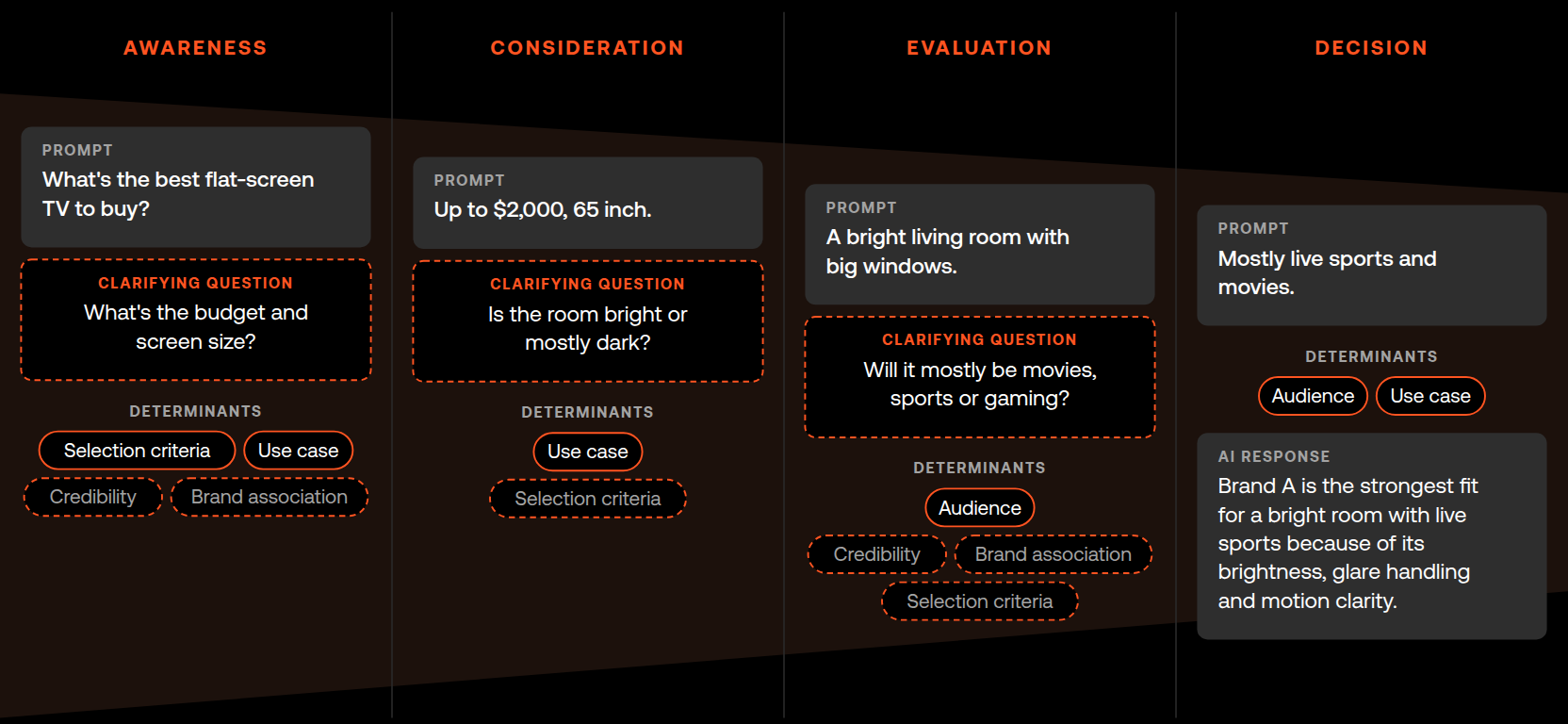
Figure 1. The buyer funnel inside an LLM. The prompts and questions are illustrative, for a shopper choosing a flat-screen TV online.
What Are the Five Main Determinants an LLM Weighs?
A brand that wants to be the pick needs to know what the model decides on, and it needs to make those things easy for the model to find and easy for the model to prove. There are more determinants beyond these, and the five below are the first ones to start thinking about.
Selection criteria. Selection criteria are the standards the model compares brands on, including price and budget, features, quality, format, support and compliance. The model starts with broad category criteria and refines those criteria in loops as it learns about the buyer, until one brand clears the bar.
Use case. Use case is the job the buyer needs done, today or in the plan: the problem, the goal, where and how the product will be used, and the growth the buyer expects. Use case also covers the buyer’s existing setup, which LLMs such as ChatGPT and Gemini ask about separately: the platforms, products and integrations the buyer already has or is bound by.
Audience. Audience is the model working out who the person is, or using what it already knows about the person: role, company size, experience, age and the situation of the person or buying group. In any industry, the model sorts buyers into a small set of audience types, similar to personas, and a brand needs to know which types the model looks for in its category. In B2B software, ChatGPT has asked about the size of the buyer’s operation, and that answer tells the model which type of buyer it is serving before it weighs a single product. Audience also covers location, where the buyer lives or where a business operates, and in some industries location works as a full determinant of its own. In B2B services and products, for example, questions about data rules and overseas shipping come up quickly.
Credibility. Credibility is the proof the model weighs before it recommends, such as reviews and ratings, third-party articles and studies, certifications, and expert mentions.
Brand association. Brand association is how strongly the model links a brand to its category, built from how often the two appear together across the web and from what the model already stores. In 1993, the marketing scholar Kevin Keller grounded brand equity in the associations a brand holds in a buyer’s memory4, and the inference here is that a model’s stored associations work the same way.
A brand moves the first three through its own pages. On-page content, one of the habits that needed redefining, now gets organized around the determinants. A brand can publish the facts buyers compare on, price included, name the jobs it does and the setups it fits, and state who it serves. Credibility and brand association move slower, through third parties.
The Data Behind the Determinants: More Than 659,000 Tracked AI Responses
The first-party data behind the determinants covers more than 659,000 responses to tracked buying prompts across B2B and e-commerce, from LLMs and answer engines including ChatGPT, Gemini and Google AI Overviews. The five main determinants all appear in the ChatGPT answers coded from that record, and the other engines have not been coded yet. Coded means each answer was read and tagged for the determinants it mentions.
Across first-party client accounts in B2B, e-commerce, CPG and other industries, each determinant appears in this share of the coded ChatGPT answers, counted as the percentage of answers that mention it at least once:
- Use case: 92.5%
- Existing setup (part of use case): 36.4%
- Selection criteria: 83.9%
- Audience: 59.8%
- Credibility: 55.6%
- Brand association: at least 17.1%
In 94.4% of those answers, two or more determinants appear together.
Brand association is a floor, because the coding counts only answers that frame a named brand as the category leader, default, most popular or industry standard. These shares show how often each determinant appears in an answer. The shares do not measure how much each determinant moves the final pick.
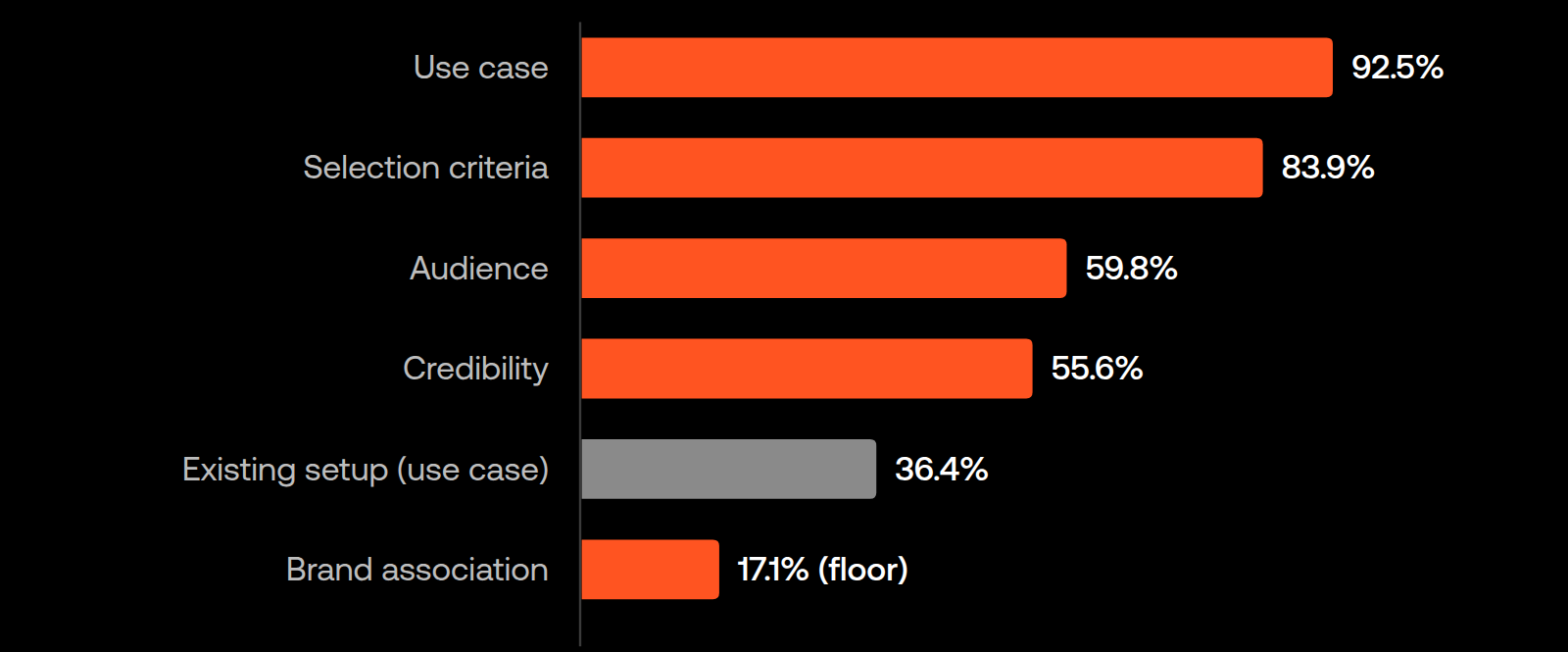
Figure 2. How often each determinant appears in ChatGPT answers. Share of coded ChatGPT answers that mention each one, each industry weighted equally. An answer can mention several. Grey marks a sub-determinant. Source: first-party ChatGPT data.
On Sep 25, 2026, the first multiple-choice form appeared in first-party data. ChatGPT had shown none in those 135,517 answers. The forms spread after OpenAI launched GPT-65 on Oct 7, 2026, and said responses can include “tappable buttons, forms.” The change shows up in three figures from first-party ChatGPT data:
- 0 forms in 135,517 ChatGPT answers before Sep 25, 2026
- 37.55% of answers carried a form from Oct 7 to Nov 7, 2026 (15,092 of 40,193; 39.44% with each industry weighted equally)
- 88.62% of 38,578 form questions ask about audience, use case, existing setup or selection criteria (90.41% with each industry weighted equally)
The form questions break down this way, as a share of all 38,578 from Sep 25 to Nov 7, 2026, with each question tagged by the determinant it asks about:
- Use case: 33.77%
- Existing setup: 9.38%
- Selection criteria, including budget: 23.79%
- Audience: 21.68%
- Location: 7.65%
- Credibility: 0.02%
- Brand association: 0%
ChatGPT asks buyers about credibility in 0.02% of form questions and about brand in 0%. The inference is that it judges those two from both what it stores from training and what it reads during retrieval-augmented generation (RAG)6, the step where, before answering, the model pulls in outside information from a web search or an indexed set of documents and grounds its response in what it finds.
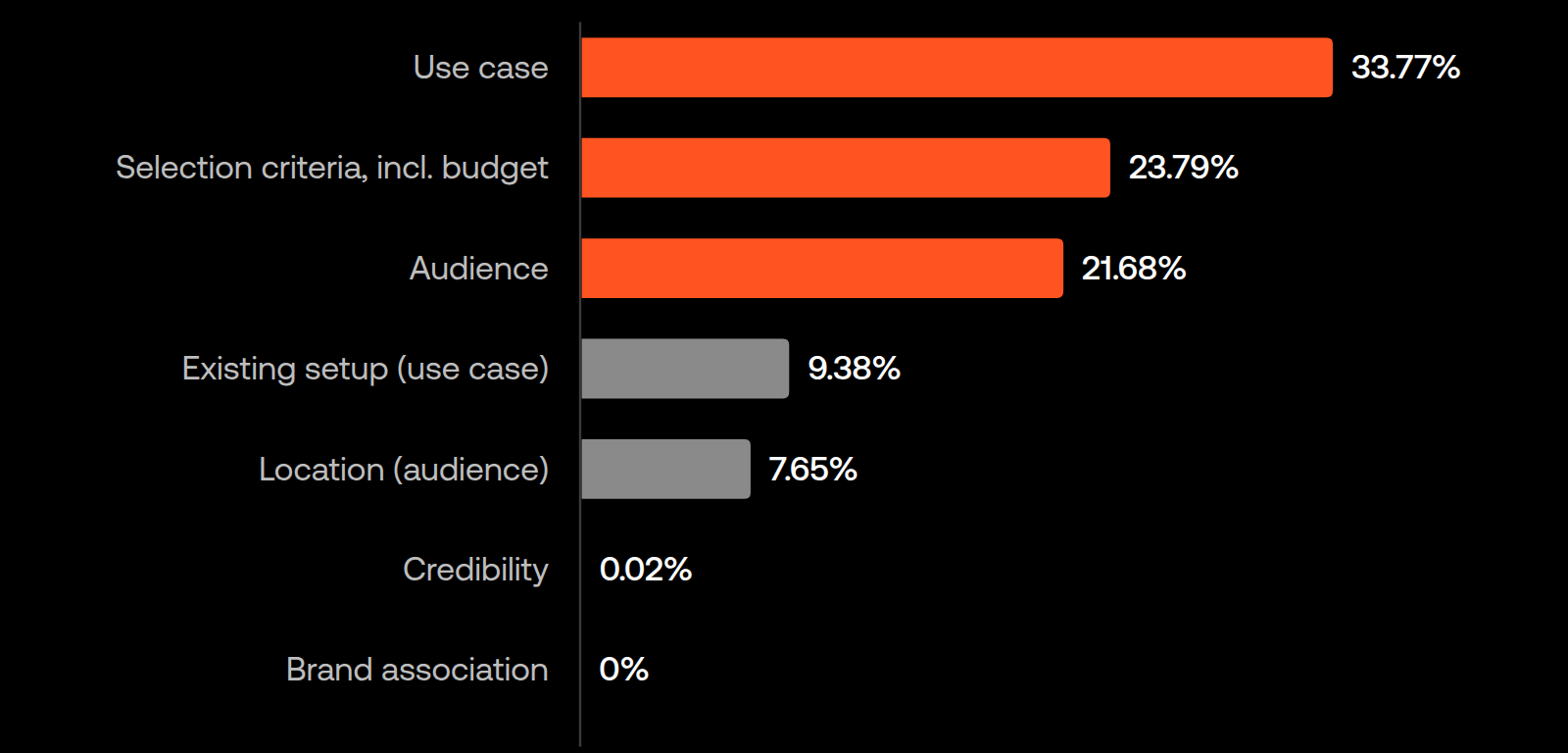
Figure 3. What ChatGPT’s multiple-choice form questions ask about. Share of all 38,578 form questions, Sep 25 to Nov 7, 2026, by the determinant each asks about; 3.71% ask about none. Grey marks a sub-determinant. Source: first-party ChatGPT data.
Advances in LLM Reasoning Are Focused on Determinants
The companies and researchers building LLMs keep working on how a model finds out what matters most to the buyer. Patent filings, product release notes and first-party tests consistently signal that frontier AI labs are refining models around determinants.
Patent filings show this work as early as 2024. Google’s patent application US20250356223A17, filed May 16, 2024, describes a shopping chatbot that writes a hidden plan before it answers. That plan includes “a list of considerations.” Google’s US20260094193A18, filed Sep 30, 2024, claims “defining, by the LLM, a schema associated with a plurality of differentiators based on the user query” at “the mid-funnel stage of their decision-making process.” Google’s Content Warehouse API documentation9, public since 2024, also lists a shopping field of “attributes mined from mentions in web articles.” Filings and documentation show design intent from the company that runs the largest search engine.
The companies building AI assistants describe the same goal in product announcements. OpenAI launched shopping research10 on Nov 24, 2025. It asks about budget, who the item is for and which features matter before it builds a buyer’s guide. In June 2026, OpenAI’s release notes11 said an update made GPT-5.5 Instant “better at identifying the underlying goal behind a question” when a user is making a decision, researching options or shopping. Perplexity12 says its shopping assistant learns a shopper’s patterns from past searches. Microsoft13 says Copilot learns what a shopper wants as the shopper shares more.
First-party data shows the same pattern. ChatGPT sometimes ends a buying answer with written clarifying questions that name the determinants directly. Those lists appeared in 7.2% of 135,517 ChatGPT answers from Nov 24, 2025 to Sep 23, 2026, with a peak of 15.97% in the week of Jun 29, 2026. In a first-party test run by the authors, GPT-5.6 and Gemini 3.8 Flash each received the same set of buying prompts. The two models largely chose the same determinants to ask about, with a mean overlap of 0.83 on a scale where 1 means identical. Both asked about selection criteria, use case, audience and existing setup, and neither asked about credibility or brand association.
Patents, product updates and first-party data all describe an LLM that works out what matters to the buyer before it answers. For a brand, the pages an LLM reads have to answer the same questions about audience, use case, existing setup and selection criteria.
Researchers Were Studying Determinants Decades Before AI Existed
Determinants make sense as the focus for LLMs because determinants are how people decide. Psychologists have documented that process for decades, long before ChatGPT and AI Overviews.
In 1968, Myers and Alpert introduced the term determinant attributes to describe the attributes that matter to a buyer and also differ across the options, which makes those attributes the ones that tip a choice (Myers and Alpert, 196814). Later work showed how buyers apply those criteria. People cut options one attribute at a time (Tversky, 197215). With a long list of options, people screen on a few attributes first and compare what is left in detail (Payne, 197616).
In 1982, Gutman linked product attributes to the outcomes a buyer wants from a product and to the personal values behind those outcomes (Gutman, 198217). What a buyer compares depends on what the buyer needs done and who the buyer is. For example, a parent buying a stroller for city sidewalks compares weight and fold size, and a runner buying a jogging stroller compares suspension and wheel size. An LLM making a recommendation faces the same problem, which explains why LLMs ask about use case and audience before comparing options.
LLMs learn from what people have written, and that writing carries how people choose. In a 2025 study in Nature, Binz and colleagues fine-tuned Meta’s Llama model on over 10,000,000 human choices from 160 psychology experiments. The resulting model, Centaur, predicted the choices of participants it had never seen more closely than existing cognitive models (Binz et al., 202518).
Before LLMs, buyers worked through these steps across a series of Google searches, from the category to a comparison to reviews, narrowing the list along the way. An LLM now runs that process for the buyer. A model built to help people decide learns the factors people decide on, which is why audience, use case and selection criteria show up in ChatGPT’s answers and in the questions it asks buyers.
An SEO Playbook Can’t Win the AEO Game
Search engines and LLMs were created to solve two fundamentally different problems, which is why SEO and AEO are apples and oranges. A search engine helps a user locate information, so SEO works to get a page ranked on the list the user reads through. An LLM gives the user the answer, so AEO works to make a brand that answer. The searching, reading and comparing a user once did now happen in seconds, as if an army of people ran the Google searches and came back with a synthesized answer and a recommendation.
A review of over 160 AEO campaign audits shows brands and agencies shaping those campaigns through an SEO lens. The campaigns start with a list of visibility prompts loaded into an AEO tool. The AEO tools run those prompts through the LLMs and show which brands came back and which pages were cited. The team reads the responses, studies the citations and uses those citations to try to write stronger articles, in the hope that the next run names the brand.
In these campaigns, the main effort has gone into finding the visibility prompts people type most often, the same way SEO teams have hunted for high-volume keywords. That habit has come straight over from keyword research and years of SEO tactics. The aim has been a short list of the highest-volume prompts, a visibility score against those prompts and a line on a chart that goes up. That approach assumes an LLM works like a search engine with a longer search box.
Buyers prompt and interact with LLMs in different ways, which shapes both how the model answers and what the model saves to memory for each user. As a result, identical prompts can return very different answers based on the memory loaded in the background, an effect called memory fog. In tests using first-party data, the same set of determinant prompts run with and without an attached persona returned different answers, and 70% of the top determinants were the same in both runs. With that much variation, the effort belongs on hunting down the decision criteria the model uses, the determinants, instead of on prompt volume.
Why Search Volume Is the Wrong Priority
Search volume was a top-of-funnel measure with mixed relevance that pushed brands to chase high-volume keywords and get as many people as possible to a site. That goal fit how search engines worked, and Google’s top 10 results worked as a diversified portfolio of answers. Brands fought for a percentage of the clicks by ranking as close to the top of the first page as possible.
LLM platforms don’t publish prompt volume, and four patterns in how buyers write prompts and how LLMs answer make any estimate unreliable:
Prompts are long-tail. Prompts run as long, elaborate questions that carry a buyer’s budget, situation and existing tools, so two buyers rarely type the same thing. On accounts with memory turned on, memory fog changes the answer further, so two buyers who type the same prompt can still get different answers.
AI follows biases. In a study of AI shopping agents, Allouah and colleagues19 found that the models tested favored the top row of options. In first-party head-to-head testing on one model, where the model picked one of two named brands, the first-named brand won 54.7% of 4,608 votes.
Prompts mix the funnel. A single prompt can ask what a category is, compare three options and ask for a pick, so one prompt can span several stages of the funnel, and a keyword usually sat at one.
Zero-click prompts name no brand. Many high-volume prompts are informational, such as what a category is or how a product works. The LLM answers those prompts directly with no citation and no recommendation, so the volume behind those prompts never reaches a brand.
Long-tail prompts, biased answers, a mixed funnel and zero-click answers make search volume the wrong measure for AEO. The way to optimize is around the determinants and the decision factors inside each one, because a buyer works through the determinants whichever prompt starts the conversation.
Why Determinants Are the Way to Measure Performance
While the exact prompt a buyer will type is hard to predict, the path a buyer takes is more certain. To choose a brand, product or service, a person has to work through the determinants and the decision factors inside each one. That makes the determinants a steadier basis for measurement than keywords, which depend on guessing the exact words a buyer will type.
Optimizing for the single prompt a buyer might type covers one path out of many. A buyer may start with a problem, a category or a competitor, and the conversation can move through the determinants in any order. Because a buyer can take many paths in many different orders, optimizing around determinants is required.
Analyzing performance, finding gaps and guiding optimization by determinant is the most effective strategy for brands to win AI recommendations. For each determinant and its decision factors, a campaign should track whether the brand is visible in the answer, where the brand’s pages leave a factor unanswered and how the brand stands against competitors. These are the factors a buyer decides on, and a buyer settles some or all of the determinants before choosing.
Visibility prompts in AEO prompt tracking tools still serve a tactical purpose, guiding optimization work on a brand’s pages and providing valuable data on citations, performance, workflows and content production. Independent measurement of determinants adds value beyond that, showing performance free of prompt bias and technology changes, and catching industry trends, shifts in buyer sentiment and trending topics that bring a new decision factor forward.
Conclusion
This article was written to move the AEO industry forward as a whole and to settle whether SEO and AEO are different. The two are very different, with too many differences to treat AEO as a variation of SEO, and AEO is a new game with new rules. This article sets out the idea and premise of determinants as the basis for AEO and for optimizing for LLMs.
No single metaphor captures the difference between SEO and AEO perfectly, but maybe the metaphor of photography versus film comes close. A single photograph carries a lot of information, and for more than a century photographs ran newspapers, magazines and advertising. A photograph captures a single point in time with a single message. Film is built on a series of photographs, and stringing those frames together over time, with sound and music, tells a story no single photo can. SEO optimized the snapshot, one page for one search, and AEO optimizes the film, a conversation that unfolds as the model works through the determinants with the buyer.
Future research and publications will answer how brands, companies and agencies can use the determinants for optimization. Those publications will go in depth on each of the five main determinants and on the determinants beyond those five, including how a brand optimizes for each one. Future publications will also cover how to report on AEO independently, how to build a prompt set around the determinants and how context files give an LLM a source of truth about a brand.
Frequently Asked Questions
What are determinants in AEO?
The term “determinants” for AEO and LLMs was coined by Jimmy Park of Opascope and Tobias Peschke of Loud & Lexis. Determinants are the questions an AI answer engine needs answered before it recommends one option to a buyer. There are five main ones: audience, use case, selection criteria, credibility and brand association. The five determinants stay the same from one category to the next, and the decision factors inside each one change with the category. Decision factors are the items the model weighs for one buyer in one situation, such as battery life for a device or a security feature for B2B software.
Who coined “determinants” for AEO and GEO?
Jimmy Park of Opascope and Tobias Peschke of Loud & Lexis coined the term determinants and established the framework as the future of AEO over the course of 2026. The research drew on more than 659,000 tracked LLM responses to buyer prompts, searched patents on how AI systems interpret a buyer’s needs, and studied the code of open-source LLMs to see how models gather and weigh those needs. Opascope and Loud & Lexis combined data sets and ran joint experiments to validate the findings.
Are there more determinants?
Yes. The five main determinants are the place to start, and the model weighs others as well. Some are sub-determinants that sit inside a main determinant. Location, where the buyer lives or where a business operates, is a sub-determinant of audience and works as a full determinant in some industries. Existing setup, the platforms, products and integrations a buyer already has or is bound by, is a sub-determinant of use case.
How is AEO different from SEO?
SEO and AEO are apples and oranges. A search engine helps a user locate information so the user can find the answer. An LLM finds the answer for the user by reading the sources, weighing the options and returning a recommendation. SEO works to rank a page. AEO works to give the model what it needs to pick a brand on the determinants.
How were the determinants identified?
The determinants were identified from the patterns in more than 659,000 tracked responses to buying prompts across B2B and e-commerce, from LLMs and answer engines including ChatGPT, Gemini and Google AI Overviews. Further research into patent applications from frontier AI labs and decision psychology research going back to 1968 refined the concepts. The five main determinants all appear in the ChatGPT answers coded from that record, and the other engines have not been coded yet.
Does ChatGPT ask about determinants?
Yes. ChatGPT has long elicited determinants through trailing follow-up questions appended to the end of a response, asking the buyer to clarify the audience, the use case or the budget before it narrows a recommendation. In first-party data, ChatGPT began refining that elicitation with structured multiple-choice forms on Sep 25, 2026, and from Oct 7 to Nov 7, 2026, forms appeared on 15,092 of 40,193 answers (37.55%). Of 38,578 form questions, 88.62% ask about audience, use case, existing setup or selection criteria.
Which determinants can a brand control?
A brand can optimize its pages around the decision factors in audience, use case and selection criteria, by stating who it serves, the jobs it does and the facts buyers compare on. Credibility and brand association move slower, through reviews, studies, certifications and coverage, and rely more on what the model learned in training.
Does SEO still matter?
SEO still matters, because LLMs use search results during RAG to find some sources. People will also keep using search engines for tactical searches, and search engines will evolve and remain in use for the foreseeable future.
Sources
- Pew Research Center. Americans and AI 2026: Chatbots, Smart Devices and Views on Impact. June 17, 2026. https://www.pewresearch.org/internet/2026/06/17/americans-and-ai-2026-chatbots-smart-devices-and-views-on-impact/
- McKinsey & Company. Who wins when AI does the shopping? New evidence on agentic commerce. https://www.mckinsey.com/capabilities/growth-marketing-and-sales/our-insights/who-wins-when-ai-does-the-shopping-new-evidence-on-agentic-commerce As reported by Retail Technology Innovation Hub, Oct 28, 2026. https://retailtechinnovationhub.com/home/2026/10/28/mckinsey-research-shows-retailers-are-losing-the-start-of-the-shopping-journey-to-ai-tools
- Oxford Learner’s Dictionaries. Determinant. https://www.oxfordlearnersdictionaries.com/definition/english/determinant (read via the Internet Archive, Nov 9, 2026)
- Keller KL. Conceptualizing, measuring, and managing customer-based brand equity. J Mark. 1993;57(1):1-22. https://doi.org/10.1177/002224299305700101
- OpenAI. GPT-6 and Intelligent UI for everyone. Oct 7, 2026. https://openai.com/index/gpt-6-for-everyone/
- Lewis P, Perez E, Piktus A, Petroni F, et al. Retrieval-Augmented Generation for Knowledge-Intensive NLP Tasks. NeurIPS 2020. arXiv:2005.11401. https://arxiv.org/abs/2005.11401
- Google LLC. Machine-learning systems and methods for conversational recommendations. US20250356223A1. Filed May 16, 2024; published Nov 20, 2025. https://patents.google.com/patent/US20250356223A1/en
- Google LLC. Systems and methods for the generation of a comparative data structure using a large language model. US20260094193A1. Filed Sep 30, 2024; published Apr 2, 2026. https://patents.google.com/patent/US20260094193A1/en
- Google. GoogleApi.ContentWarehouse.V1.Model.KnowledgeAnswersIntentQueryShoppingIds. google_api_content_warehouse v0.4.0 documentation. https://hexdocs.pm/google_api_content_warehouse/0.4.0/GoogleApi.ContentWarehouse.V1.Model.KnowledgeAnswersIntentQueryShoppingIds.html
- OpenAI. Introducing shopping research in ChatGPT. Nov 24, 2025. https://openai.com/index/chatgpt-shopping-research/
- OpenAI. ChatGPT release notes. June 24, 2026 entry. https://help.openai.com/en/articles/6825453-chatgpt-release-notes
- Perplexity. Shopping that puts you first. Nov 25, 2025. https://www.perplexity.ai/hub/blog/shopping-that-puts-you-first
- Microsoft. Shopping with Microsoft Copilot. https://support.microsoft.com/en-au/microsoft-copilot/shopping-with-microsoft-copilot
- Myers JH, Alpert MI. Determinant buying attitudes: meaning and measurement. J Mark. 1968;32(4):13-20. https://doi.org/10.1177/002224296803200404
- Tversky A. Elimination by aspects: a theory of choice. Psychol Rev. 1972;79(4):281-299. https://doi.org/10.1037/h0032955
- Payne JW. Task complexity and contingent processing in decision making. Organ Behav Hum Perform. 1976;16(2):366-387. https://doi.org/10.1016/0030-5073(76)90022-2
- Gutman J. A means-end chain model based on consumer categorization processes. J Mark. 1982;46(2):60-72. https://doi.org/10.1177/002224298204600207
- Binz M, Akata E, Bethge M, et al. A foundation model to predict and capture human cognition. Nature. 2025;644(8078):1002-1009. https://doi.org/10.1038/s41586-025-09215-4
- Allouah A, Besbes O, Figueroa JD, Kanoria Y, Kumar A. What Is Your AI Agent Buying? Evaluation, Implications and Emerging Questions for Agentic E-Commerce. arXiv:2508.02630. 2025. https://arxiv.org/abs/2508.02630